
For families
Homeschool socialization: what a well-built week looks like
Meadow View Learning4 min read
Key takeaways
- Judge the environment your child will spend the week in, not the word 'homeschool' by itself, since the two are not the same thing.
- Look for regular, repeated contact with the same group of peers rather than occasional playdates, because repetition is what builds real friendship.
- Consider a multi-age setting for at least part of the week, since mixed ages mirror how children actually interact at church and at home.
- Build in at least two recurring peer commitments each week, such as a co-op day and a team or club activity, so your child sees the same faces regularly.
- If you're weighing a tutorial center or microschool, ask specifically how the week is structured for peer interaction, in addition to which subjects are covered.
Homeschool socialization worries usually come down to one thing: does your child see the same peers, regularly, in a setting with real structure? Homeschooling itself does not hurt a child's ability to make friends; the shape of the week does.
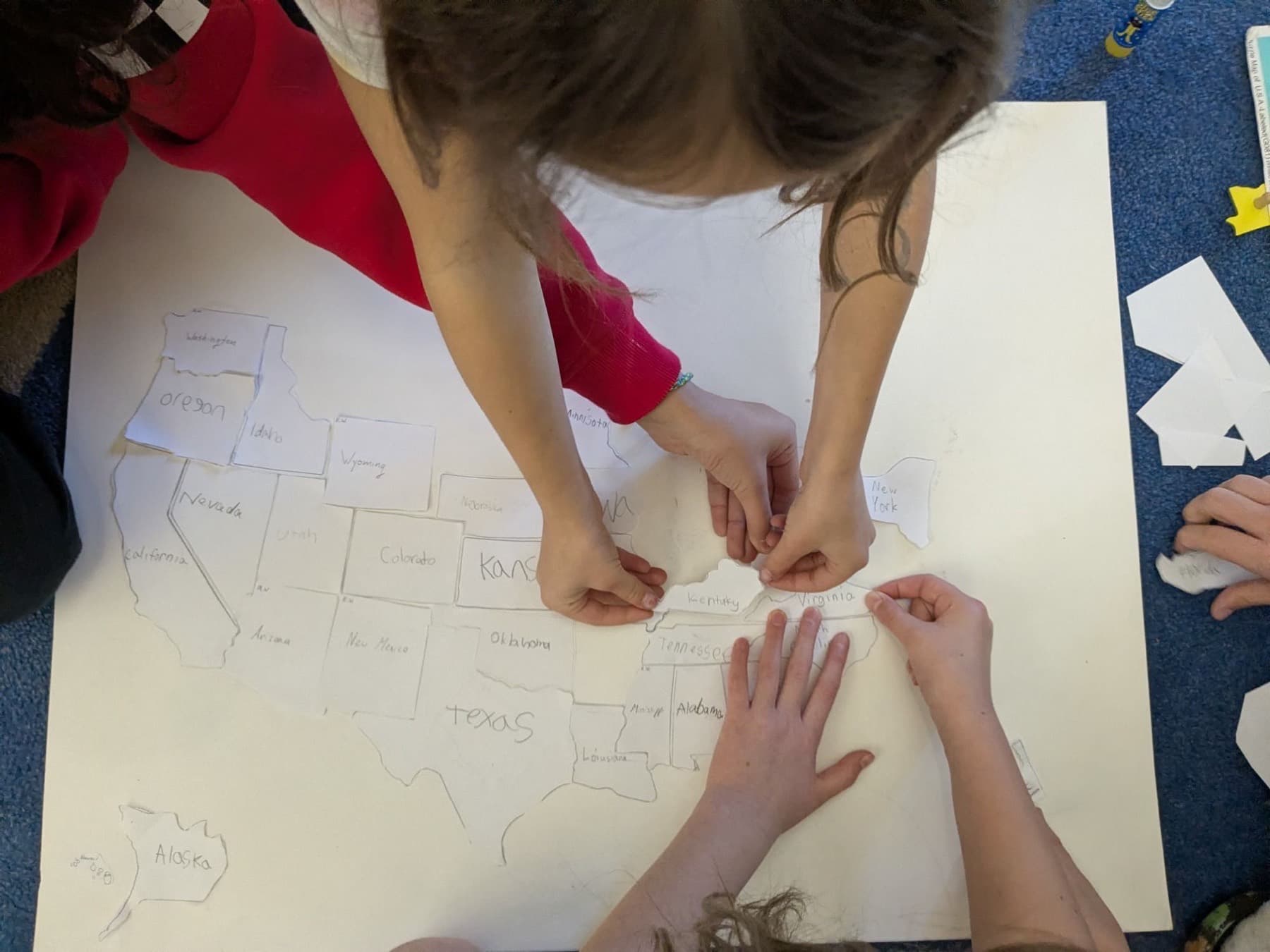
Picture children on the floor of a classroom in Rocklin, piecing together a hand-drawn map of the United States, working out state by state where each one goes. That's what a socially rich week can look like on a Tuesday morning, and it doesn't require a bus, a cafeteria, or three hundred same-age classmates.
What does the research actually say about homeschooling and social skills?
The honest answer is that this depends heavily on the specific setup, not on the label "homeschool" itself. Research published through Stetson University reviewed the studies on this question and found that homeschooled children scored higher than traditionally schooled children on the communication, daily living skills, socialization, and social maturity subscales of a standard measure of social development. In its own study of children in grades five through eight, that same paper reported social-skills percentile ranks ranging from 55 to 94, every one of them above the 50th-percentile average for public school students. What's clear without a study is the mechanism: a child isolated at a kitchen table develops differently than a child who spends the week among peers in a structured group.
The real question to ask about any specific program is what the week actually contains, day to day, for your child.
What does a socially rich homeschool week actually look like?
In a well-built week, a child works alongside the same small group of peers most days, rather than only occasionally. Mornings might involve guided instruction in a small group; afternoons might mean hands-on projects, a S.T.E.M. and Engineering & Design Lab session, or V.A.P.A. Club on a Tuesday afternoon. Some weeks include Frontier Girls, which meets on second Thursdays.
Character and faith formation, where a family wants that, tend to work best woven through the ordinary business of the day rather than confined to a single period on a schedule. A child who spends the week solving problems next to the same eight or so peers, several days running, gets far more repeated social practice than a child who sees a rotating cast of strangers at a park day once a month.
Why do multi-age groups matter more than a same-age classroom?
Outside of school, children spend most of their lives among people of mixed ages: siblings, cousins, a church youth group, a family gathering. A multi-age group of roughly eight learners across a three-year span gives a nine-year-old a chance to be mentored by the oldest child in the group and, a year later, to mentor the youngest one in it.
That rotation teaches patience and leadership in a way a room of twenty-five same-age peers rarely does, because there is always someone a little ahead and someone a little behind. The approach behind mixed-age groupings explains why we group this way, if it's new to you.
What can a parent do to build in social opportunities without a campus?
If your child is homeschooling at home rather than in a group setting, the fix is not more unstructured playdates. It's a repeating schedule: the same co-op class every Tuesday, the same team practice every week, the same small group that meets on a predictable day. Repetition is what turns acquaintances into friends, and a once-a-month park meetup rarely gets there.
A structured tutorial center or learning community can do some of this work for you, by putting your child among the same peers for full or partial weeks rather than leaving peer contact to chance. Look at what a typical week of programs includes before deciding how much of that structure you want to outsource and how much you want to keep at home.
Does socialization look different in elementary versus the middle and high school years?
In the elementary years, the work itself is screen-free and hands-on: wooden materials, real books, a floor map assembled by hand. That kind of work produces a lot of incidental talking and negotiating between children, exactly the low-stakes social practice a young child needs.
By middle and high school, the social task shifts. Older students start using technology deliberately, in an engineering lab or a research project, and the skill in demand moves from sharing a workspace to collaborating on a shared deadline. A program built for older students should reflect that shift instead of repeating the elementary format at a higher reading level.
The single most useful thing you can do this week, whatever you decide about a full program, is put two recurring peer commitments on the calendar: one class or co-op your child attends on the same day every week, and one team, club, or group that meets on a regular schedule. If you'd like to talk through what a full week could look like for your child, book a fifteen-minute call.
Frequently asked questions
- Do homeschooled children get enough social interaction?
- They can, but it depends entirely on how the week is built, not on the fact of homeschooling itself. A child who sees the same group of peers several times a week, in a setting with real structure and shared work, tends to do fine; a child with no regular peer contact at all will struggle, homeschooled or not.
- Does a learning community or microschool help with socialization?
- It can, because it gives a child repeated contact with the same small group of peers under adult guidance, several days a week, rather than occasional outings. Multi-age groupings in particular give children practice talking to people older and younger than themselves, which is closer to real life than a single-age classroom.
- What activities help homeschooled kids build real friendships?
- Anything that happens on a repeating schedule with the same group of children works better than one-off events: a weekly club, a team sport, a co-op class, or a scouting-style group that meets monthly. Friendship tends to grow out of shared, repeated work more than out of pure free play.
- Is socialization harder for only children who are homeschooled?
- It can take more deliberate planning, since there's no sibling group at home to practice negotiation and conflict with. A structured group setting, even a few days a week, usually fills that gap well: it puts an only child among peers on a predictable schedule rather than leaving social contact to chance.